Showing posts with label DCA. Show all posts

Thursday, June 3, 2021

Which strategy is most profitable, chasing the “rising stars”, abandoning the falling ones, or holding?


Photo by rupixen.com on Unsplash

Dear Readers,

Thank you for coming here!


If you do investing, I am sure you have wondered which strategy is most profitable.

There are tons of discussions, researches, theories, and even bets regarding this. 

And there still does not seem to be a dominating answer.

I read a report from the China Merchants Bank on 2020 investment returns, which I think can provide a good reference for you.

So I would like to share it with you in this blog.


First of all, if you are not familiar with the China Merchants Bank, it is the fastest growing bank in China with the most advanced technology and best customer user interface, with probably the best investment value. 

I still keep my account with them.

In 2020, the size of the funds managed by the Bank was around 700Billion RMB. It is said to be the largest in the market.

In my opinion, the size is significant enough to make the report “reasonably representative”.
From Internet, translated by Author

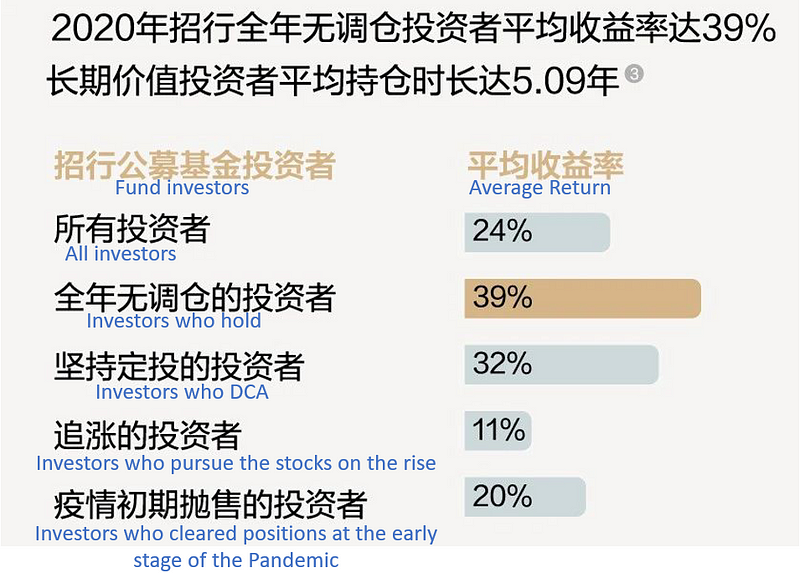
So going into the report, the average return for all investors is 24%, which is great. This would make the perfect advertisement for them.

Do take note that this was in 2020, so before the drop caused by the profit-taking in Feb/Mar.

If we look at the different groups of investors, investors who hold achieved the highest return of 39%, 63% higher than the average.

Followed by the investors who DCA at 32%, 33% higher than the average.

Investors who try to time the market, either by pursuing the funds on the rise or clearing positions before the pandemic to avoid the fall achieved the lowest, at 11% and 20% respectively, well below the average.

I think a big reason is the deep and narrow “V” we experienced last year. No one would expect it to rebound so fast. 

So those who sold would not have time to re-act. And those who pursue would have come in at higher prices.

So again, timing the market is hard.

Photo by Anto Fredric on Unsplash

So where was I in this?

Haha, I cleared my positions after the pandemic rebound, at about 5% above the pre-pandemic high.

At that time, I believed that the fundamental to support the market valuation was not strong enough and I was not drawing any salary and could not afford much risk.

So I missed a large part of the upward trend…

Well, life goes on and so must the learnings.


Happy investing!


Till next time!

Friday, March 19, 2021

Cannot "Buy Low and Sell High", then How?

Photo by Etienne Girardet on Unsplash

Dear Readers,

Thank you for coming here!


I wrote in my last post that I started to regret the lost opportunities for adding positions, now that the stock market is up from the lows. This causes anxiety.

And this is typical FOMO (Fear Of Losing Out). I lost out because I did not top up at the lowest points, compared to those who did.

But if I had FOMO, why didn’t I just get in and deploy all my war-chest?

You are right! Because of FOBO (Fear Of Better Options).

What if the prices drop further? This also causes anxiety.

So I constantly feel anxiety, struggling between FOMO and FOBO.

SO how? Can we avoid the anxiety and at the same time achieve good outcomes?

Photo by Samuel-Elias Nadler on Unsplash

The fundamental reason of feeling endless anxiety is that we embrace “Fear/Panic” instead of “Curiosity”.

“Curiosity” means exploring, accumulating knowledge and making discoveries.

“Fear/Panic” implies speculation and gambling. 

Therefore, to avoid anxiety, we need to feel that investing is interesting and we are willing to really dig deep to understand how it really works, without caring about gains or losses.

Every fluctuation is but another opportunity to learn and understand the behavior of the market.

We need to forget about making money.

Photo by pixpoetry on Unsplash

What?!

I hear you because I think the same way: this is too hard.

So is there any other way?

I can only see one: Find a “Rule” and stick to it.

The “Rule” is something we can predict and reply on in the somewhat random market. 

The “Rule” represents certainty in the market full of uncertainties.

You can borrow from others or engineer your own and refine it along the way. 

But note that the purpose of the “Rule” is not to achieve the best outcomes, but to reduce anxiety with acceptable outcomes.

Just like the law, whose purpose is not to ensure justice, but to end dispute.

Therefore, do not dwell on buying at the lowest points and selling at the highest points. That is just not possible.

If you still find it hard to let go of the “hope” for best outcomes, just think of this way: the chances of achieving better outcomes are not higher in any other way, even with the anxiety. 

It is totally likely to have anxiety and worse outcomes at the same time.

Photo by Mark Duffel on Unsplash

So what are some of the “Rules” we can apply?

Well, DCA (Dollar-Cost-Averaging) is definitely one. 

I tried to stick to it for about two years. While I cannot say much about the outcomes, the anxiety I felt was definitely much less than with my current investment approach.

But since I have decided to try something different from DCA, I will share another “Rule” which is more complex.

The 37% Rule.

We can split every decision making into two phases:

  1. The first 37% of the time, to explore and establish the “Baseline” without making any decision
  2. The remaining 63%, to pick the first opportunity that is equal or better than the “Baseline”

This is a statistically proven conclusion. Do not ask me how. I used to be able to understand complicated matters as this. Now I am just too lazy to try.

However, I am still able to illustrate its application.

For example, we want to invest SGD2000 in a particular stock every month. 

However, we can only have the money after pay day, say 15th of the month.

So at what price should we invest?

The first 37% of a month is ~11 days. So until 26 of the month, we should observe the market and establish the “baseline”, which is not necessarily the lowest price in the 11 days.

Then for the remaining 19 days, from 27th to the 15th of next month, we should just buy at the first opportunity when the price reaches the “Baseline” or below. We could simply place a “Limit order” that is valid for 19 days.

Statistically, this approach will give you relatively good outcomes.

Photo by Kelly Sikkema on Unsplash

In Summary

Struggling between FOMO and FOBO will bring endless anxiety and probably bad outcomes.

The fundamental solution is to embrace “Curiosity” to explore and understand how things really work, without worrying about the outcomes.

The next best alternative is to pick a “Rule” and stick to it. The certainty the “Rule” brings will reduce anxiety.

Do note that the purpose of the “Rule” is not to achieve the best outcomes, but to reduce anxiety with acceptable outcomes.

“DCA” and “The 37% Rule” are some examples.


Till next time!

Friday, December 18, 2020

Will DCA into ETF still work in the current market?

Photo by Jamie Street on Unsplash

Dear Readers,

Thank you for coming here!


I listened to a sharing earlier this week about money. Among the guests are Adam Khoo, a few seasoned private bankers, fund managers, business owners and, last but not least, a CIO managing multi-billion assets.

The sharing provided quite some insights regarding investment and the current markets. 

I would like to share them with you in this post.


1.Regarding DCA (Dollar cost averaging) into ETFs

While experts still think DCA into EFTs are generally a good way of investing for completely passive investors, they do have some concerns.

For ETFs, the experts are not simply into world ETFs. They are looking at ETFs in certain industries or segment, which totally makes sense as they are professionals.

For DCA, the discussion became very interesting.

First of all, they all reflected that individual investors seldom had the discipline to stick to DCA. 

From my own experiences, I shamefully support the statement. 

I always tried to time the market when it was time to DCA, hoping to get a slightly better price by waiting for a few days or months.

Secondly, one expert reminded that instable cash flows also limited people’s capability to stick to DCA. 

Again, from my own experiences, I shamefully support the statement.

I always thought I was conservative in the DCA amount until I became jobless. The assumption that things will continue going well limited my investment into risk management.

Thirdly, another expert suggested to join a community of like-minded people to utilize the peer pressure/encouragement to stick to DCA, which was quite refreshing. 

Even though he was pitching his services, this could be a very good way to maintain financial discipline, not just DCA.

If you are already part of a such community, congratulations.

If you can find your friends and relatives to form such a community, I would suggest you do so asap.

If you are like me, neither in a community nor having the network to form one (or simply do not want to discuss this kind of matters with your current network for whatever reason), please leave a comment below. If there are more than a few, I can start a community and see how it goes.


2.Regarding the current markets 

[Disclaimer: below is based on my understanding only. Please read on your own risk.]

The market is a bit expensive now and wealth preservation is getting popular.

Suggestion to “what to do now” was to find out what you wanted first. (Whatever that means)


3.Regarding mistakes and lost opportunities 

Everyone makes mistakes, no matter how good they are.

In Apr-May this year, when markets started to recover, very few people were bullish about the market then. 

Even the CIOs of many reputable money managing giants were bearish and instructed their bankers to tell their clients to stop buying or even continue selling. 

A few bankers were rumored to be “F”ed by their clients.

So even professionals make mistakes, we, individual investors, should not be too hard on ourselves.

Photo by Herman Delgado on Unsplash

So after the sharing and thinking back my own experience, I have decided to be more conservative in my investment:

  1. Cut down the DCA amount when I resume it (I have not re-started it since I stopped about one year ago, but I think this is still my approach going forward). 
  2. This will allow me to accumulate a war chest over time to prepare for the unexpected or even better to invest lump-sums when the markets go down. I need to overcome the anxiety I have when I have cash sitting idly in bank accounts.


Hope we all become better investors!


Till next time!