Showing posts with label decision making. Show all posts

Tuesday, September 21, 2021

Danger is a fact, but fear is a choice

Photo by Raúl Nájera on Unsplash

Dear Readers.

Thank you for coming here! 


World is full of danger, but fear is a choice.

We know the danger is real, because shit has happened so many times;

We know the fear is real, because we have been put through very difficult situations so many times.

We can be extremely conservative to avoid the danger as much as possible.

But that could be the danger itself.

One typical example is someone saying “No” to better job offers to avoid the risk in the transition and the “danger” of “cannot make it”.

However, the danger will be real when his current job goes downhill or when his growth potential disappears.

He may not be able to secure another comparable position when he needs to, because he has been in his comfortable zone for too long.

So it is “danger” no matter he takes the offer or rejects it.

Photo by Javier Allegue Barros on Unsplash

So how?

While it is a fact that the danger exists, it is a choice how we deal with the fear.

From a practical point, focusing too much on fear only paralyzes us. We have to live with it and be cautious along the way.

To do that, it is advisable to think it through before making the decision.

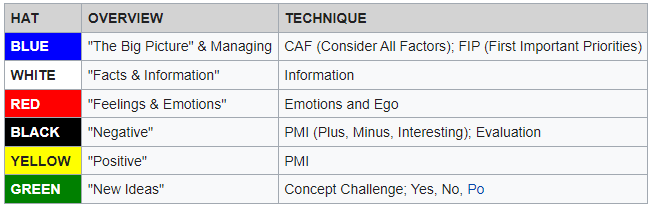
A good tool is the Six Thinking Hat, where we take on different “roles” and “perspectives” to assess the same issue.

That way, we are our own “Think Tank”.

While “Blue” and “White” hats typically are used in the beginning of the process, there is no restriction on the sequence of the hats and how many times we can put on each hat.

From my experience, decision typically comes to us while we have the “RED” hat on, which means we start to feel confident that this is “right” or “wrong” after round(s) of collecting facts and information, structuring thoughts, assessing positive and negative aspects and trying to come out with creative ideas to deal with problems at hand.
From Internet

However, no methodology or tool can guarantee right decisions.

So the next part is implementation and consequence management.

Photo by Sigmund on Unsplash

During implementation, it is important that we stay cautious. 

The biggest risk comes when we start to feel too confident or even arrogant after some intermediate successes.

We start to get lazy. 

We start to base our decisions on imaginations, instead of facts.

We start to think we are above certain things or people.

We start to avoid communication and feedback.

etc etc

Mistakes are almost bound to happen and they will mostly likely take us by surprise.

The result?

Serious set-backs, painful experiences and even scars. 

Their impact can last well beyond the short term.

Photo by Bradyn Trollip on Unsplash

We do our best in implementation. 

But when consequences happen, no matter the reason, we need to accept them, bear them and take the full responsibility for them.

Afterwards, we will work to improve things.

It is almost never the end game unless we accept it.

And when a door closes, a window will open.

No need to hurry. It could take some time for us to see the window.

The most important thing is to put ourselves together and set out again.

Never underestimate our own resilience. 

And by the way, this will happen a few times in life for most people.

We just cannot avoid them.

Call it fate.
Photo by the blowup on Unsplash

If we are blessed with success at the end of implementation, enjoy it and use it as our next starting point if we want to keep going (no shame in stopping if that is what we want).

Most importantly, never forget to be grateful.

Remember there are people who are equally qualified for success, but suffering from set-backs due to factors they have little control over.

If we know them, we should help them.

What comes around goes around and what goes around comes around.

Photo by Kelly Sikkema on Unsplash

In the end

Danger is a fact, but fear is a choice.

We have to live with fear and keep going forward.

Try to think it through before making decisions.

Try to stay cautious during implementation.

Bear the consequences and work to improve things.

When met with success, be grateful and help others.

To us all!


Till next time!


Friday, March 19, 2021

Cannot "Buy Low and Sell High", then How?

Photo by Etienne Girardet on Unsplash

Dear Readers,

Thank you for coming here!


I wrote in my last post that I started to regret the lost opportunities for adding positions, now that the stock market is up from the lows. This causes anxiety.

And this is typical FOMO (Fear Of Losing Out). I lost out because I did not top up at the lowest points, compared to those who did.

But if I had FOMO, why didn’t I just get in and deploy all my war-chest?

You are right! Because of FOBO (Fear Of Better Options).

What if the prices drop further? This also causes anxiety.

So I constantly feel anxiety, struggling between FOMO and FOBO.

SO how? Can we avoid the anxiety and at the same time achieve good outcomes?

Photo by Samuel-Elias Nadler on Unsplash

The fundamental reason of feeling endless anxiety is that we embrace “Fear/Panic” instead of “Curiosity”.

“Curiosity” means exploring, accumulating knowledge and making discoveries.

“Fear/Panic” implies speculation and gambling

Therefore, to avoid anxiety, we need to feel that investing is interesting and we are willing to really dig deep to understand how it really works, without caring about gains or losses.

Every fluctuation is but another opportunity to learn and understand the behavior of the market.

We need to forget about making money.

Photo by pixpoetry on Unsplash

What?!

I hear you because I think the same way: this is too hard.

So is there any other way?

I can only see one: Find a “Rule” and stick to it.

The “Rule” is something we can predict and reply on in the somewhat random market. 

The “Rule” represents certainty in the market full of uncertainties.

You can borrow from others or engineer your own and refine it along the way. 

But note that the purpose of the “Rule” is not to achieve the best outcomes, but to reduce anxiety with acceptable outcomes.

Just like the law, whose purpose is not to ensure justice, but to end dispute.

Therefore, do not dwell on buying at the lowest points and selling at the highest points. That is just not possible.

If you still find it hard to let go of the “hope” for best outcomes, just think of this way: the chances of achieving better outcomes are not higher in any other way, even with the anxiety. 

It is totally likely to have anxiety and worse outcomes at the same time.

Photo by Mark Duffel on Unsplash

So what are some of the “Rules” we can apply?

Well, DCA (Dollar-Cost-Averaging) is definitely one. 

I tried to stick to it for about two years. While I cannot say much about the outcomes, the anxiety I felt was definitely much less than with my current investment approach.

But since I have decided to try something different from DCA, I will share another “Rule” which is more complex.

The 37% Rule.

We can split every decision making into two phases:

  1. The first 37% of the time, to explore and establish the “Baseline” without making any decision
  2. The remaining 63%, to pick the first opportunity that is equal or better than the “Baseline”

This is a statistically proven conclusion. Do not ask me how. I used to be able to understand complicated matters as this. Now I am just too lazy to try.

However, I am still able to illustrate its application.

For example, we want to invest SGD2000 in a particular stock every month. 

However, we can only have the money after pay day, say 15th of the month.

So at what price should we invest?

The first 37% of a month is ~11 days. So until 26 of the month, we should observe the market and establish the “baseline”, which is not necessarily the lowest price in the 11 days.

Then for the remaining 19 days, from 27th to the 15th of next month, we should just buy at the first opportunity when the price reaches the “Baseline” or below. We could simply place a “Limit order” that is valid for 19 days.

Statistically, this approach will give you relatively good outcomes.

Photo by Kelly Sikkema on Unsplash

In Summary

Struggling between FOMO and FOBO will bring endless anxiety and probably bad outcomes.

The fundamental solution is to embrace “Curiosity” to explore and understand how things really work, without worrying about the outcomes.

The next best alternative is to pick a “Rule” and stick to it. The certainty the “Rule” brings will reduce anxiety.

Do note that the purpose of the “Rule” is not to achieve the best outcomes, but to reduce anxiety with acceptable outcomes.

“DCA” and “The 37% Rule” are some examples.


Till next time!

Tuesday, February 9, 2021

Here is why average investors lose out in stock investing


Photo by Jason Briscoe on Unsplash

Dear Readers,

Thank you for coming here!


Have you ever done below?

  • Sold a great stock at a 10 or 20% gain, only to see it skyrocket shortly after
  • Held a bad stock for the longest time, only to see it drop to the bottom

If you have done so and more than a few times, you are definitely NOT alone. 

I am with you totally. I have done this with quite a few stocks for quite a few times in my not-so-long investment journey.

When I recalled my experiences and my thinking process leading to the decisions, I realized that it was due to the mismatch between the behavior of the Stock Market and the behavior of my own.

The stock market, maybe most of the things in this world, follows Matthew Effect, while my behavior followed Anchoring Effect and Mean Reversion.

Let me explain.

Photo by Brendan Church on Unsplash

1.Matthew effect for the stock market

Matthew effect, simply put, is

  • The strong get stronger and the weak get weaker
  • The rich get richer and the poor get poorer

If you meet your university peers 2 or 3 years after graduation, you wont see much difference in most of them. They will be in similar levels of their career and making roughly the same pay as you. You might disagree with me by pointing out that some of them make twice as much as the others (6k vs 3k), such as banking and consulting employees. But trust me, the difference of a few thousand is nothing, compared to what is coming.

If you meet them 10 years after graduation, you will see a huge gap between those who are doing well and those who are just getting by. For example, those who get into the leading start-ups in the Tech industry could be already financially free, while some others are struggling to keep their jobs amid Covid.

If you meet them 30–40 years after graduation, probably you will have nothing to talk about rather than the common experience you had in University.

Those who do well will do better, while those who don’t will get worse.

This is also the case in the stock market.

The capital inflow concentrates on the leading companies in good industries, pushing their stock prices higher and higher. 

On the other hand, the rest of the stock will continue to tank due to lack of capital.

The more mature the stock market, the more obvious the trend.

In the US, this has been the case for a long time: trades concentrate on leading stocks.

In China, the trend has officially been recognized this year. In January, the index climbed up while more than 2/3 of the stocks dropped in prices. 

The days for shorting penny stocks are over.

So, in stock market, the trend is that good stocks will command higher and higher prices, while bad stocks will suffer from lower and lower interests and prices.

Photo by Grant Durr on Unsplash

2.Anchoring Effect and Mean Reversion for my behavior

Anchoring effect is “a cognitive bias where an individual depends too heavily on an initial piece of information offered (considered to be the “anchor”) to make subsequent judgments during decision making”.

Mean reversion is “a theory implying that asset prices and historical returns gradually move towards the long-term mean”.

Anchoring effect makes me treat the stock price when I start to track it or the buying price as the baseline.

Mean reversion makes me believe that the stock price will tend to revert back to the baseline.

Therefore, when a stock price rises by 20%, I start to believe that it will revert soon and start selling.

When a stock price drops by 20%, I again start to believe that it will revert soon and continue to hold or start buying.

Therefore, I can only hold good stocks for short term and enjoy limited gains, but hold bad stocks for the longest time and suffer big losses.

Photo by Kelly Sikkema on Unsplash

Summary

On one hand, good stocks will command higher and higher prices, while bad stocks will suffer from lower and lower interests and prices.

On the other hand, the average investors suffer from treating their buying price as baseline and believing that the stock prices will revert back to it. 

As a result of the mismatch, they let go of the great stocks at 10–20% gain while holding on to the bad stocks which will bring them higher and higher losses.

So true that we need to go against human nature to succeed in investing!


Till next time!

Thursday, January 28, 2021

3 “Wisdom” to have a “Big Say” in life!

Photo by Tingey Injury Law Firm on Unsplash

Dear Readers,

Thank you for coming here!


How to have a “Big Say” in life and achieve success and happiness?

We need “Wisdom”. The world is too complex and uncertain, we need “Wisdom” to guild us.

How much “Wisdom” one possesses could be the factor to set people apart.

In life, we need 3 “Wisdom”: The “Wisdom” to choose, stick to our choice and game with the world.


Photo by Javier Allegue Barros on Unsplash

1.The Wisdom to Choose

Life is full of choices and we define our lives with the choices we make.

Should I start my own business or live a corporate life?

Should I choose City A or B?

Should I marry Ruby or Debby?

Should I eat Nasi Lemak or Kway Chap for lunch?

Fortunately and Unfortunately, there are only a few critical choices we get to make in our lives.

However, many of us do not (want to) know we have choices and do not have the courage to choose.

Why do many of us not know the choices we have?

If you are reading this, you are living in a time of peace and abundance. You have the right to choose, which is the freedom people in history crave for.

Think about Frank.V.E., the author of “Man’s Search for Meaning”. He lived in desperate conditions, saw his peers disappearing day by day and chose to have hope and dignity while waiting for his turn. 

He kept the “last freedom” mankind can have: the freedom to choose attitude.

Compared to him, we have the freedom to choose. No matter our choices, the chances of us ending up in his situation is almost non-existent.

The only problem is whether we realize it or rather whether we want to realize it.

Are we just repeating our lives every day, knowing that we are not as happy as we can be but keeping telling ourselves that we do not have a choice, because of kids, housing loans etc etc

Do we really not know that we have a choice to change or do we just not want to know?

Why do many of us not have the courage to choose?

Even through we realize the choices we have, many of us still dare not to make the call.

Because choosing one means giving up the other.

Starting your own business is exciting and fulfilling, but it is also hard work with too many uncertainties.

Going into corporate is stable with good benefits, but it is also boring and dull.

So how?

Do not escape from it and do not be too greedy.

Escaping from it usually leads to the worst decision in the last minute because we either choose in the moment of stress or someone else will choose for us.

Being too greedy is no better.

You could list out all the qualities for your future soul mate. Then you list out all the possible candidates and evaluate them with different models, and then tell the “lucky girl” that she is the one.

She could tell you “Sorry, you are not my type” or even worse “While you are busy with the evaluation, I got married.”

Maybe we should learn to accept “slightly better than average” results. It will subject us to so much less trouble and pain.

Also, we need to realize “slight better than average” is not bad at all and should be appreciated.

Therefore, make the call and then enjoy the benefits or bear the consequences. 

Always remember: How bad could it be?

Photo by Patrick Tomasso on Unsplash

2.The Wisdom to Stick to Our Choice

To stick to our choice, first we need to stop ourselves from revisiting the choice we have made more than necessary.

Do not look back. Once the choice is made, focus on making it right.

The only time to revisit and make adjustment is when critical new information and development become known. 

However, we need to be clear about the core logic behind the decision and stick to it.

The second thing we need to be aware of is distraction.

There are so many nowadays. They can come to us disguised as opportunities, wealth, love etc etc

The right way to counter it is a phase I have used probably too much — “Long-Term”.

Jeff Bezos pushed his “Flywheel” for 20 years and became the richest person in the world, because “It’s All About Long-Term”.

He had countless opportunities to raise the profit margin of Amazon and push the stocks higher. But he did not to stick to the Long-Term.

Probably, shareholders have doubted him or even blamed him.

Maybe, he never thought of giving this up, because all he cares is Long-Term.

Make the choice and give it time by sticking to it.

Photo by Zoe Holling on Unsplash

3.The Wisdom to game with the world

The world is full of competitions in all aspects.

It is an elegant technique to achieve what we want in the interactions with others, e.g. negotiations.

We need to “Game” with the world, as in “Game Theory”. 

And remember, most of the time, we are not playing one-time games.

So how to game?

One mindset and one tactic.

Mindset : Win-Win & Gratitude

Always try to achieve Win-Win. This is the only way to maintain a healthy long-term working relationship.

As a consultant, say no when you know you cannot solve the clients’ problem.

In a project, lower your margin to allow some margin for the other party too.

Gratitude is not only the right thing to do, but also a necessary condition to attract partners.

Will you work with someone who has the reputation of being ungrateful? 

Even if you do, it is only for the moment. Once the short-term goal is achieved, you are gone. 

And you know during the short cooperation, you need to constantly keep an eye on the other party.

Win-win and gratitude do not guarantee the maximized benefits for us now, but for the Long-Term.

Tactic: Repeat the last choice of your opponent

In a repeated game, repeat the last choice of your opponent gives the best results, by computer simulation.

Always being a nice guy will attract bullies; Always being a bully will repel others.

“Blood for blood” is a protection to ourselves.


Photo by Kelly Sikkema on Unsplash

In summary, make your choice decisively, stick to it for the Long-Term and repeatedly game with world, until you achieve your goals.

This is what sets people apart!

This is how to have a “Big Say” in our lives!


Till next time!

Wednesday, December 30, 2020

Why “Sunk Costs” still sink people?


Photo by Jason Blackeye on Unsplash

Dear Readers,

Thank you for coming here!


It is quite common that people still make bad decisions because they cannot let go of “Sunk costs”. 

I am the living example. I still feel very very bad due to my career set back this year. Sometimes, the feeling was so strong that it shows on my face and affects my efficiency in getting things done.

Another well-known scenario is as follows: if you bought a movie ticket to a bad movie, will you just leave half way? 

I do not know about you, but I probably won’t…haha

Photo by Natasya Chen on Unsplash

So the problem here is why we just cannot let go of the “Sunk Costs” and move on, even though we know we should logically.

It would be lazy to just say “Knowing is oceans apart from doing” (I will do an entry on that later).

So I really thought about the “why”. And I now think there might be two reasons that are deeply linked to our nature as a human being.

1. Fear of losses

Compared to the same amount of gains, the emotions triggered by losses are twice as much.

That means the joy we get from gaining 1000 dollars is only half of the suffering we get from losing the same amount of money.

So people hate and fear losses.

“Sunk costs” are gone by definition. 

But if we turn away from it, it would mean that it is really “lost” and becomes actual “losses”. This is obviously just some mental games. It is lost already.

2. Fear of being proven wrong

I struggled a bit between “Fear of being proven wrong” and “Fear of being wrong”.

I decided to use the former. 

Maybe people are ok to be wrong and preferably correct themselves “quietly”. “Quietly” means that they do not even realize it themselves. This way, no explicit emotions are triggered.

However, “being proven wrong” represents a logical and conscious conclusion, which will trigger emotions.

So people are more afraid of “being proven wrong”.

And making a conscious decision to give up the “Sunk Costs” proves people wrong, even if that is the right decision to make for themselves.


These two “fears” are closely and deeply linked to our human nature. They are hard to defy and thus “Sunk Costs” are hard to let go.

However, there are ways in which we can increase our chances of success.

Photo by Stillness InMotion on Unsplash

1.Understand “Sunk Costs” are not costs

Costs are forward looking.

Costs are something you need to give up moving forward.

“Sunk Costs” were incurred in the past. We do not need to give up anything going forward.

So “Sunk Costs” are not costs.

To make the right decision, we need to consider the real costs, which leads us to the second point.

2.Consider the “Opportunity Costs” 

“Opportunity Costs” are the real costs.

It is the value of the best alternative we have to give up by making a decision.

If we decide to join a company, we are giving up the growth and wealth brought to us by other companies;

If we decide to marry someone and spend the rest of our lives with him/her, we are giving up the companionship of anyone else in the world;

If we decide to watch a movie tonight, we are giving up the joy and influence of any other movies.

So this is what will make a meaningful distinction to our lives going forward.


Hope we all make as many good decisions in our lives!


Till next time!