“Being a manager means you cannot always be the nice guy you want to be”
I have been told this a while back. But I kind of refused to accept it.
So I have been trying my best to deliver quality results while being nice, even though this often means I have to work extra hard and even though sometimes I do not even get the recognition/understanding for my good intention.
But just as all people who do not accept reality, I come to the pivotal point.
I start to push harder and demand more, while knowing that this is still within the reasonable range.
After all, the success of the team depends on every member of the team doing their part.
Otherwise, the team wont be as efficient or effective as it should be, even though some members are willing to take the extra load.
Just imagine when such a team goes head to head against another team which has a manager who can ensure everyone in his/her team does their part.
The first team will lost, no matter how hard the manager works.
And when that happens and everyone in that team loses their jobs, it is hard not to pin the manager on the failure board. How hard he works does not matter.
Contrary to popular belief, I now realize that keep trying and trying harder may not increase our chances for success.
There are two reasons:
We might be on the wrong track or just in an environment that would not support our success. Maybe we are doing work that we are not good at. Or maybe some factors just prevent us from realizing our full potential. Take for example the former team member in my previous post.
We might be doing the same things over and over again without improving.
Compared to the #1, #2 might be more common and dangerous.
Being in #1, we will be miserable and we will find ways to get out sooner or later.
Being in #2, we might have the illusion that we are making progress. And worse still, we could really be deep in our comfortable zone and do not want to get out.
We need to master the effective and efficient way of learning in whatever we do. Different ways of learning might work for different domains and definitely for different persons.
We need to keep practicing and improving.
We need to keep high-quality thinking all the time!
Do not ask me how to achieve the above 3 things. I do not know yet.
And it is not only gaming that might do this to us.
In Chinese Kongfu movies/novels, it is far too common that the character falls into a cave or a lake and then discovers some superb marshal arts manual or weapons. And then he emerges as the best Kufu master, takes his revenge, gets the perfect girl and rules the world.
Here, the marshal arts manual and the weapons are the “Cheats”.
In western super hero movies/comics, people get their super power from accidents. For example, Spiderman gets it from a spider bite and Hulk from a failed experiment. And then they rely on that super power to save humanity.
Here, the accidents, the bite or radiation, are the “Cheats”.
These very very attractive “Cheats” are shortcuts that do not really exist in reality.
They might seem to exist, but they do not.
Once we fall into the habit of relying on “Cheats”, that is the beginning of the bitter end.
Gradually, we convince ourselves to believe in more and more “cheats” and waste time and money on them, without any sustainable results.
A good example is my investment journey.
I changed my approach from Dollar Cost Averaging (DCA) into broad indexes to buying individual stocks, just because my wife’s return surprised me.
And then I started speculating.
All this while, I never really sat down to research a sector or company.
Even by luck, I had very good returns in the first few months, I was not able to pocket it.
And now I am sitting at huge losses.
In comparison, to select the DCA approach to kick start my investment journey, I spent months in researching and only after that, I made the decision based on my style and sound logic.
And even if it did not bring me stellar returns, I was seldom in the Red Zone.
The misconception of reality will translate into tangible losses.
While it is a fact that the danger exists, it is a choice how we deal with the fear.
From a practical point, focusing too much on fear only paralyzes us. We have to live with it and be cautious along the way.
To do that, it is advisable to think it through before making the decision.
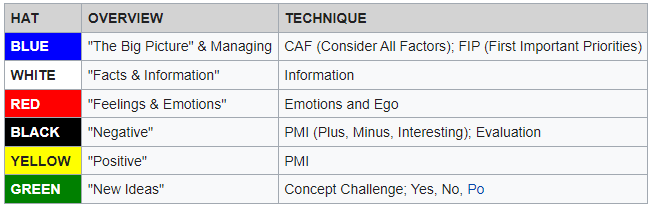
A good tool is the Six Thinking Hat, where we take on different “roles” and “perspectives” to assess the same issue.
That way, we are our own “Think Tank”.
While “Blue” and “White” hats typically are used in the beginning of the process, there is no restriction on the sequence of the hats and how many times we can put on each hat.
From my experience, decision typically comes to us while we have the “RED” hat on, which means we start to feel confident that this is “right” or “wrong” after round(s) of collecting facts and information, structuring thoughts, assessing positive and negative aspects and trying to come out with creative ideas to deal with problems at hand.
From Internet
However, no methodology or tool can guarantee right decisions.
So the next part is implementation and consequence management.
If we are blessed with success at the end of implementation, enjoy it and use it as our next starting point if we want to keep going (no shame in stopping if that is what we want).
Most importantly, never forget to be grateful.
Remember there are people who are equally qualified for success, but suffering from set-backs due to factors they have little control over.
If we know them, we should help them.
What comes around goes around and what goes around comes around.
If you have attended job interviews before, have you ever wondered what people who sit on the opposite side of the table or camera are thinking, while you show off your experiences and smart responses?
I conducted 15 interviews in the past 4 working days.
I have conducted interviews before, but never of this scale or intensity.
Interviewing candidates and trying to pick the right one is hard work.
First of all, you have to write the JDs and fix the title, grade, pay range…
Then, you have to go through several dozens of resumes to pick the candidates for interviews.
Then, you have to prepare the questions for the interviews so that you give the candidates opportunities to showcase their qualities and fit.
Then, you have to make yourself available, which could mean a lot of rescheduling and over time.
During the interviews, you have to explain the role and your expectations to the candidates, 15 times of the same conversation.
You have to ask candidates questions and listen to their responses and observe their behaviors.
Then you have to tailor the subsequent questions and try to have a conversation.
Then you ask them whether they have any questions and answer them.
All the while, you are trying to have a good read on his/her fit, and form your opinion and fill in the evaluation form.
Meanwhile, you try to make the interview a good experience for the candidates, so that they do not feel frustrated or a waste of time afterwards.
After the interview, you have to compare notes with other interviewers and see whether you miss any important points and seek confirmation on points you are unsure about.
If there are written cases, you have to prepare, distribute and grade them…
Of course, HR will always come with admin procedures you have to follow.
Interviewers go through all the hard work and struggles to select the right candidate for the position.
So they really want you to succeed. That means their job is done.
So do yourself a favor and come ready to show your best qualities for this job.
And sometimes, just showing your commitment is enough.
After the first two days, we were so frustrated as we could not see any good candidate.
One of the directors said:
If any of the internal candidates went to the database (they all have access to) and came with a simple analysis telling me this was how I saw your area, the job would be his.
If any of the external candidates told me I had been doing nothing but reading about your company and role and this was what I found out so far, the job would be his.
Unfortunately, no one did.
And the process had to go on.
I really feel bad for the three internal candidates. The role is a promotion for them and they could just grab it with some initiative on their end.
Therefore, prepare, show your commitment and help the interviewers select you and end the process.
Being able to communicate the picture clearly and make your audience understand is more important and a lot harder to do.
I always knew it would be hard, because people are very likely on different frequencies, due to background, experiences, education etc etc.
However, I never expected it to be so hard.
Previously, even as a consultant when I had to communicate with people I do not know at all, I could typically manage it.
I could adapt to their styles and habits fairly quickly. After all, it was my job to make them understand and cooperate.
However, things are different now.
My new boss posted a huge challenge for me.
I just could not seem to reach the common understanding with him. Even when I thought we did, we did not, because he expected totally different things from what I delivered next time we met.
This added a lot of frustrations and pressure.
After a while, I think I kind of figured out the reason — we were talking about different “pictures”.
He was always talking about the long-term picture and I was always trying to explain and align with him the intermediate picture which was realistic and executable given our resources.
He got frustrated because he simply wanted his picture.
I was frustrated because I told him I understood his long term picture and now I would like to discuss with him what we can do to achieve it in a realistic way. Or at least, we should agree on the expectations before our next meeting.
Once I realized it, the communication has become much better.
I will simply ask him “what do you think we should do now before we meet next week?” and if he has no clue, I give him my suggestions.
This seemed obvious and unnecessary to me as well at first. But that question clearly told him that we now discuss what we do today or this week.
That establishes a common platform.
It is ok if he does not have a clue or he does not care. I will simply give my suggestions.
Sometimes, the solution is so simple.
Simple solutions typically require clear and deep understanding which is not simple to do though.
Based on my experience, I offer four pieces of suggestions.
1.Show the pictures
This is the most intuitive thing to do.
We want to explain and make people understand our pictures, so just show them.
This will be much more effective than just explaining verbally.
If we are building a PowerPoint deck, show the dummy deck.
If we are doing an analysis, show the scenarios — what are the possible outcomes and each possibility will lead to what conclusion.
If we are organizing a meeting, show the picture of the meeting venue, layout of chairs etc etc
2.Standardize rules of engagement
As much as we can, we should standard rules of engagement.
For example, terms.
In the professional world of phones, here are the terms that should be used across the board.
Model — iPhone 12 is a model
Variant — iPhone 12 128GB is a variant
SKU — iPhone 12 128GB black is a SKU
For example, deadlines.
When we set a deadline with external clients, we expect our internal preparation to be fully completed, reviewed and finalized 24 hours before the deadline.
For example, data update cycle.
If we are doing analysis in Feb, data needs to be updated at least till Jan.
…
3.Sync up
This is similar to Point 2. However, this refers to things that cannot be explicitly communicated.
I remember a documentary on The Blue Angels flight demonstration squadron.
The pilots said they spent pretty much all the time together to understand how each other thought so that they could sync up their actions to complete the beautiful maneuver without crashing into each other.
Most jobs do not require this level of sync up. But spending more time together seems to be a good way to sync up.
4.Think, analyze and summarize
Of course, with every encounter, we think, analyze and summarize. This will speed up the process.
If we could have the picture and make people understand it, we send the strong signal that we have this area under control, which sets the stage for career success.
On the other hand, if we could perfectly understand the pictures of our managers, or even come out with the pictures before he does, we are on our way to become indispensable.
My progress has again been hindered by the mistake I made 3.5 years ago.
Fair or not, it is what happened.
However, I feel not so bad about it this time!
Naturally, I was again brought back to the scene mentally.
I thought I would again feel wronged and feel like shit for a while and then helplessly move on, like so many times in the past.
To my surprise, I found myself recalling only the good “reactions” of the people involved, and that made me feel better.
Previously, I always thought I did not deserve it and resented the behaviors of some people involved in the incident.
They could have easily prevented the incident from happening. Instead, they made things worse unnecessarily.
Previously, I also told myself that I could only blame myself . But that was mostly from a practical point of view.
Punishing those people is not within my circle of influences. If it were, I believe I would have acted long time back. So I told myself I could only blame myself.
Now, however, I think I really see the point why I can only blame myself.
People were not evil and I was ultimately responsible for my own mistake, intentionally or not.
These thoughts have allowed me to feel not so bad about the recent setback.
The third reason, probably also the most important one, is that I start to take a different perspective.
Will it really be better for me to lead a busy and tough life with the hope to become successful and rich one day, compared to living a relaxing life where I can probably still have enough money to get by?
I have always pursued the former, because I want to have options, because I have the desire to prove myself and because I have been educated to do so.
After the incident, I had one more reason to stick to the former. I really do not accept that one single mistake can limit my life in any way.
I have been fighting against it.
I never really allowed myself to think about what I really want. I never thought I deserved the “luxury”.
But once I start to take that thoughts, things look different.
All the lost opportunities during the past 2–3 years, including the recent one, are basically just “trades” — I spend much more time in work and expose myself to much more pressure, to trade for much more learnings, money and higher positions.
I did not get those opportunities and therefore, I had time to maintain this blog and do many other things, including sitting in the sofa and look stupid.
The opportunities are not pure gain or loss situations. They simply allow me the option to carry out the trades.
I have been miserable for being denied those options to trade.
I have never evaluated whether those trades are indeed good for me. If they are not, why would I need the options in the first place?
Since fate has been so insistent in keeping me in the latter, maybe I should accept and relax and see where life takes me.
I can give up planning everything ahead, worrying about potential risks in the future that may never happen, and taking all the responsivities on my own shoulder. I can simply relax.
A joke was very popular over the internet a decade ago:
Living a life is like being raped. If you cannot resist, just lie down and enjoy.
Once a wise man gave his opinion:
Life is hard itself and it is fine as long as you have tried your best.
Maybe I can just relax and things could just work out, because so far, it surely feels “The harder I fight, the deeper I am trapped”.
Focus on external factors for success and internal factors for failure
If you grow up in Chinese culture, I am sure you have heard this many times.
It is usually used to educate us to stay modest and keep improving.
For most of us, we received it from our parents or teachers and we just accepted it without question until it became the “culture” or “attitude” we took for granted.
However, most of us had the moments when we doubted it and even felt unfair. How come I always came hard on myself and still was not as successful?
First of all, this “attitude” could never guarantee success. Very few things in this world can.
It can only guide us, if we still believe in it, to focus on improving ourselves, which is probably the most certain way to increase our chance for success.
Secondly, we never realized the sound “logic” behind this “attitude”.
Probably it never occurred to us that we should or need to try to understand the logic behind the statement because we were so young when we accepted it.
Any success or failure is caused by the combined effects of external and internal factors.
Then why should we focus on external factors for success?
Because the internal factors are relatively stable.
In order to complete something, what are our internal factors?
Soft ones like our mindset and network.
Hard ones like our skills and capital.
The chance of any of these changing much in the short term is very slim.
Therefore, in the short term, the success depends largely on external factors. If we want to repeat the success, we need to focus on analyzing them.
Success this time could well be a coincidence. The same efforts could fail miserably under different circumstances.
Focusing on external factors for success will help us convert the unknown and uncertainties of external factors into known and certainties for success.
So why should we focus on internal factors for failure?
Because, in the case of failure, external factors are typically constraints we cannot change.
Lack of resources, regulatory restrictions, disasters etc etc
We can only change ourselves.
When we lose a business opportunity, we can complain about lack of support from upper management and back offices; we can also complain that the client is not capable of recognizing our good value proposition; we can also complain that the opponent leverages the “grey area” to gain a unfair advantage.
However, our job is exactly to deliver success subject to these constraints. These constraints are just facts that we need to accept and dance with.
1.Don’t ask rhetorical questions or question the audience
What is a rhetorical question?
“Why don’t you do that?”
“Why have you not done that?”
What is questioning?
“Have you considered the others?”
“Do you think this is being responsible?”
It is easy to notice that all these questions are aggressive.
Behind these questions are negative emotions, such as blaming and anger, which will not help solve the problem.
These questions will only trigger defensive behaviors on the other party and eliminate the possibility for open discussions.
Therefore, never ask rhetorical questions or question the audience
2.Don’t ask a question and then answer it yourself
Asking a question and then answering it yourself, usually is only for expressing yourself, instead of obtaining additional information.
Therefore, what you are really doing is “teaching” or “telling”, instead of “learning” which questions are for.
It only shows your arrogance and hurts the communications.
3.Don’t embed assumptions in your questions
What is “embed assumptions in your questions”?
For example, “Why are your employees so unprofessional?”
This question comes with an assumption “Your employees are very unprofessional”.
This type of question is dangerous, because the assumption may not be true. But once “why” is added to the question, your attention might be drawn away.
You are no longer focusing on this assumption. Instead, you start looking for reasons for the assumption.
This is like “injecting” an assumption into your brain.
Of course, this kind of “tricks” can be much harder to spot in real life than the example above.
But people sooner or later will realize it and will feel insulted.
Therefore, we should never embed assumptions in our questions. And we need to be alert about this type of questions ourselves as well.
4.Don’t ask “Yes or No” questions
These are close-ended questions. The audience can simple answer with “Yes or No”.
These type of questions are bad in obtaining information and bring people inspirations.
Therefore, ask open-ended questions.
5.Do apply the 5W1H approach
What is 5W1H?
“What”, “Who”, “Why”, “When”, “Where”, “How”!
Any question that starts with these words could be a good question. They could be questions on facts, logic, reasoning, relationship, time or behavior.
They are open-ended questions and do not come with any pre-judgement or positioning.
Therefore, these questions are good for discussion and insight generation.
6.Do ask to confirm the facts before asking “Why”
This is a good way to avoid #3 “embed assumptions in your questions”.
So ask to confirm the assumptions first before asking “Why”.
This way, what we are doing is trying to identify the reason for the fact, instead of trying to “inject” any opinion into people’s mind.
7.Do ask follow-up questions
One question might not be enough, especially when we are dealing with more and more complex problems in our modern life.
Therefore, follow-up questions are necessary to obtain more information and drill down to the root-causes.
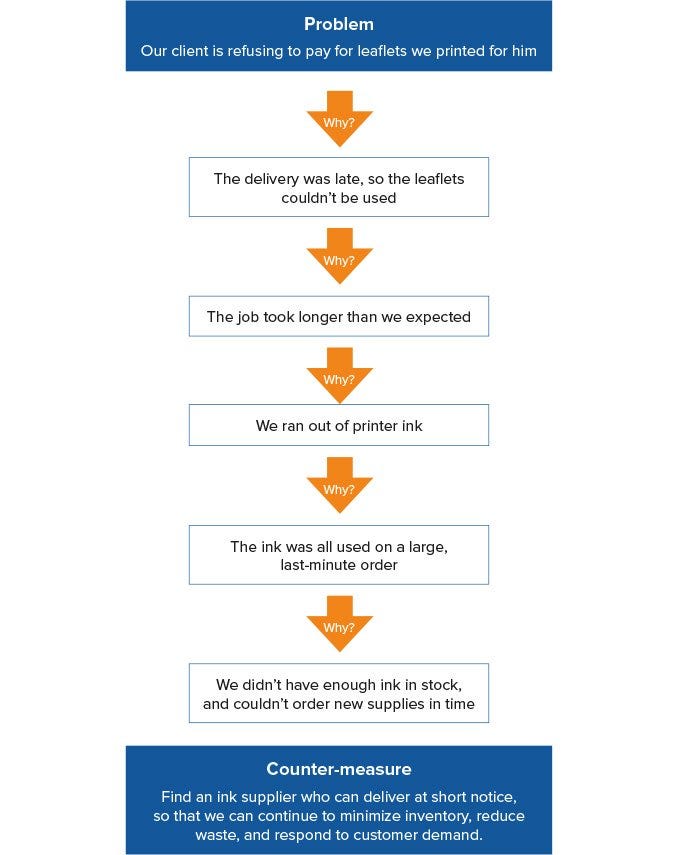
Toyota has the famous “5 Why” framework to identify the root causes of the problems.
From MindTools
So ask more “why” to drill down to the bottom of the problem.