As we just entered 2023, I would like to share with you a quick summary of 2022 from the perspective of financials.
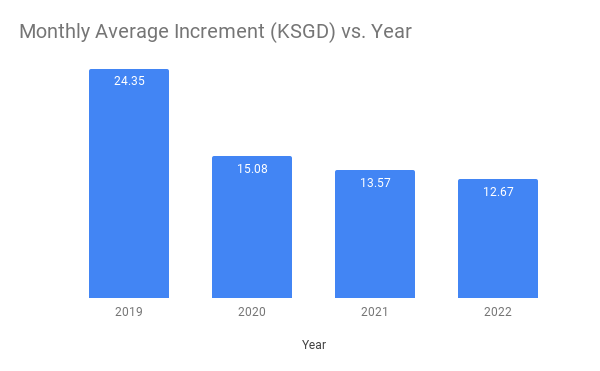
As you can see from the chat above, our Total Net-Worth (TNW) has been increasing every year, but the increment year-on-year has been dropping, which means we are further away from our 40/40 goal than 2019 while I am 3 years closer to age 40.
This is mainly due to our investment.
I was mostly out of a job in 2020, but our investment carried us through.
In 2021, it is the opposite. I got my salary back, but our investment tanked, resulting in an overall lower increment than 2020.
Our investment continued the dive, but not as drastic as 2021. I was able to hold on to my salary for the most part and most of the pay for the freelancer work I did in 2021 came in 2022. But we still had a lower increment than 2021.
Worse still, at the end of 2022, our actual TNW was lower than our conservative projection. This means we have fallen behind our projection in absolute terms, aka, we are poorer than we planned to be.
Again, investment contributed to most of it. Even we were conservative about our projection, we did not forecast a negative return on investment. But we have been in the red zone for the last 18 consecutive months.
With the market showing some signs of recovery and my new start in career, we hope to reverse this declining trend of increment and catch up with our projection in 2023.
My cousin is in University Year 3 and doing her internship. She asked me for some life advice.
I gave her some pointers and would like to share them here for my younger audience (I hope there are some :))
Your immediate focus is only Career and Marriage. The rest (bags, clothes etc etc) is a waste of time, time that you will never get back. And do not forget about the compounding impact.
Between Career and Marriage, you should prioritize Career over Marriage at least until 30. In modern cities, your career determines your circle, which determines the kind of man you can meet. Being successful in Career would enable you to find better partners, and thus increase your chance of living a happy and successful life.
You should never be a housewife in your whole life. If possible, you should maintain your independent Career and income. If not, you need to be helping your husband’s career with very clear value addition. Otherwise, the more successful your husband is, the more likely you will lose his respect and then him completely.
To do well in Career, the secret lies in every decision of yours, big or small. When you see an opportunity, do you actively pursue it or wait for it to come to you? When presented with a good relocation opportunity, do you take the challenge or shrink back into your comfort zone? After work, do you read or spend all your time on Tiktok?
Base your expectations and decisions on statistics and rules. You need to realize you are just as common as the majority of the population. That means what happens to the majority will happen to you. That means rules will not bend for you. That means you will neither be very lucky nor very unlucky. For example, your plane won't crash and you won't strike the lottery.
We might struggle between what we really want (assuming we know, which is a big IF) and what we are required of (like providing for family) or even what we are expected of (like success as society/culture defines it).
Once we have chosen what to focus on, it could be hard to stick to it.
A lot of factors are at play here too.
But one helpful way is to get into a circle with similar focus.
In the circle, we get the right atmosphere to stick to our focus and we might get help when needed.
All that makes it easier for us to stick to it and sometimes can be the difference between making it through and giving up half way.
When the time came to decide whether to keep him on, I really struggled.
I really wanted to help him, but I could not afford to keep doing his job on top of mine…
So I let him go, after giving him honest feedback and telling him that he needed a hard re-set before he could make it work and trying harder would probably not be the answer.
(To be honest, project leadership wanted to get rid of him to save budget. I was definitely affected by that also.)
When Cyberpunk 2077 first came out in Dec, I was quite busy and did not play it.
Afterwards, I was just scared off by all the ridiculous bugs, reported by players.
A friend tried Cyberpunk 2077 again recently and told me that the game was playable now after all the patches.
So I tried it also.
And I am hooked.
I have always fancied a futuristic and chaotic world. I still remember the first movie of this kind where Humans can unlock the full potential of our brains and be God-like!
Even only a few hours in the game, I can see the complexity and connections of the storyline. If it is anywhere close to the Witcher 3, it is a more than great game. CDPR’s ability is not to be underestimated.
The gameplay is good too. The shooting is definitely not the best but it is good enough for a RPG. The progression and weapon systems are good too!
All in all, I think I am going to throw lots of hours into this game.
Being able to communicate the picture clearly and make your audience understand is more important and a lot harder to do.
I always knew it would be hard, because people are very likely on different frequencies, due to background, experiences, education etc etc.
However, I never expected it to be so hard.
Previously, even as a consultant when I had to communicate with people I do not know at all, I could typically manage it.
I could adapt to their styles and habits fairly quickly. After all, it was my job to make them understand and cooperate.
However, things are different now.
My new boss posted a huge challenge for me.
I just could not seem to reach the common understanding with him. Even when I thought we did, we did not, because he expected totally different things from what I delivered next time we met.
This added a lot of frustrations and pressure.
After a while, I think I kind of figured out the reason — we were talking about different “pictures”.
He was always talking about the long-term picture and I was always trying to explain and align with him the intermediate picture which was realistic and executable given our resources.
He got frustrated because he simply wanted his picture.
I was frustrated because I told him I understood his long term picture and now I would like to discuss with him what we can do to achieve it in a realistic way. Or at least, we should agree on the expectations before our next meeting.
Once I realized it, the communication has become much better.
I will simply ask him “what do you think we should do now before we meet next week?” and if he has no clue, I give him my suggestions.
This seemed obvious and unnecessary to me as well at first. But that question clearly told him that we now discuss what we do today or this week.
That establishes a common platform.
It is ok if he does not have a clue or he does not care. I will simply give my suggestions.
Sometimes, the solution is so simple.
Simple solutions typically require clear and deep understanding which is not simple to do though.
Based on my experience, I offer four pieces of suggestions.
1.Show the pictures
This is the most intuitive thing to do.
We want to explain and make people understand our pictures, so just show them.
This will be much more effective than just explaining verbally.
If we are building a PowerPoint deck, show the dummy deck.
If we are doing an analysis, show the scenarios — what are the possible outcomes and each possibility will lead to what conclusion.
If we are organizing a meeting, show the picture of the meeting venue, layout of chairs etc etc
2.Standardize rules of engagement
As much as we can, we should standard rules of engagement.
For example, terms.
In the professional world of phones, here are the terms that should be used across the board.
Model — iPhone 12 is a model
Variant — iPhone 12 128GB is a variant
SKU — iPhone 12 128GB black is a SKU
For example, deadlines.
When we set a deadline with external clients, we expect our internal preparation to be fully completed, reviewed and finalized 24 hours before the deadline.
For example, data update cycle.
If we are doing analysis in Feb, data needs to be updated at least till Jan.
…
3.Sync up
This is similar to Point 2. However, this refers to things that cannot be explicitly communicated.
I remember a documentary on The Blue Angels flight demonstration squadron.
The pilots said they spent pretty much all the time together to understand how each other thought so that they could sync up their actions to complete the beautiful maneuver without crashing into each other.
Most jobs do not require this level of sync up. But spending more time together seems to be a good way to sync up.
4.Think, analyze and summarize
Of course, with every encounter, we think, analyze and summarize. This will speed up the process.
If we could have the picture and make people understand it, we send the strong signal that we have this area under control, which sets the stage for career success.
On the other hand, if we could perfectly understand the pictures of our managers, or even come out with the pictures before he does, we are on our way to become indispensable.
Sadly, many people unlock the first level with diligence, and just assume that diligence is the master key — one key to unlock them all.
As a result, they are trapped in the first level forever, no matter how hard they try.
As a matter of fact, the harder they try, the more firmly trapped they are.
Some of them will believe by mistake that the reason why they cannot enter the next level is that people upstairs have locked the door from the other side.
Therefore, many of them complain and become cynical, but never think of trying a different key.
We need to clearly remember and firmly believe that, as our stages change, some of the beliefs we hold dearly to our heart, whether inherited or picked up along the way, will become completely wrong and hurt us.
Every stage has its rules and we need to learn, experiment and adapt.
This world runs by its rules, which are deeply rooted in evolution. And it will not overly accommodate anyone.
Therefore, successful people are the ones with the strongest adaptability. They have no time to complain or have their feelings hurt.
1.Don’t ask rhetorical questions or question the audience
What is a rhetorical question?
“Why don’t you do that?”
“Why have you not done that?”
What is questioning?
“Have you considered the others?”
“Do you think this is being responsible?”
It is easy to notice that all these questions are aggressive.
Behind these questions are negative emotions, such as blaming and anger, which will not help solve the problem.
These questions will only trigger defensive behaviors on the other party and eliminate the possibility for open discussions.
Therefore, never ask rhetorical questions or question the audience
2.Don’t ask a question and then answer it yourself
Asking a question and then answering it yourself, usually is only for expressing yourself, instead of obtaining additional information.
Therefore, what you are really doing is “teaching” or “telling”, instead of “learning” which questions are for.
It only shows your arrogance and hurts the communications.
3.Don’t embed assumptions in your questions
What is “embed assumptions in your questions”?
For example, “Why are your employees so unprofessional?”
This question comes with an assumption “Your employees are very unprofessional”.
This type of question is dangerous, because the assumption may not be true. But once “why” is added to the question, your attention might be drawn away.
You are no longer focusing on this assumption. Instead, you start looking for reasons for the assumption.
This is like “injecting” an assumption into your brain.
Of course, this kind of “tricks” can be much harder to spot in real life than the example above.
But people sooner or later will realize it and will feel insulted.
Therefore, we should never embed assumptions in our questions. And we need to be alert about this type of questions ourselves as well.
4.Don’t ask “Yes or No” questions
These are close-ended questions. The audience can simple answer with “Yes or No”.
These type of questions are bad in obtaining information and bring people inspirations.
Therefore, ask open-ended questions.
5.Do apply the 5W1H approach
What is 5W1H?
“What”, “Who”, “Why”, “When”, “Where”, “How”!
Any question that starts with these words could be a good question. They could be questions on facts, logic, reasoning, relationship, time or behavior.
They are open-ended questions and do not come with any pre-judgement or positioning.
Therefore, these questions are good for discussion and insight generation.
6.Do ask to confirm the facts before asking “Why”
This is a good way to avoid #3 “embed assumptions in your questions”.
So ask to confirm the assumptions first before asking “Why”.
This way, what we are doing is trying to identify the reason for the fact, instead of trying to “inject” any opinion into people’s mind.
7.Do ask follow-up questions
One question might not be enough, especially when we are dealing with more and more complex problems in our modern life.
Therefore, follow-up questions are necessary to obtain more information and drill down to the root-causes.
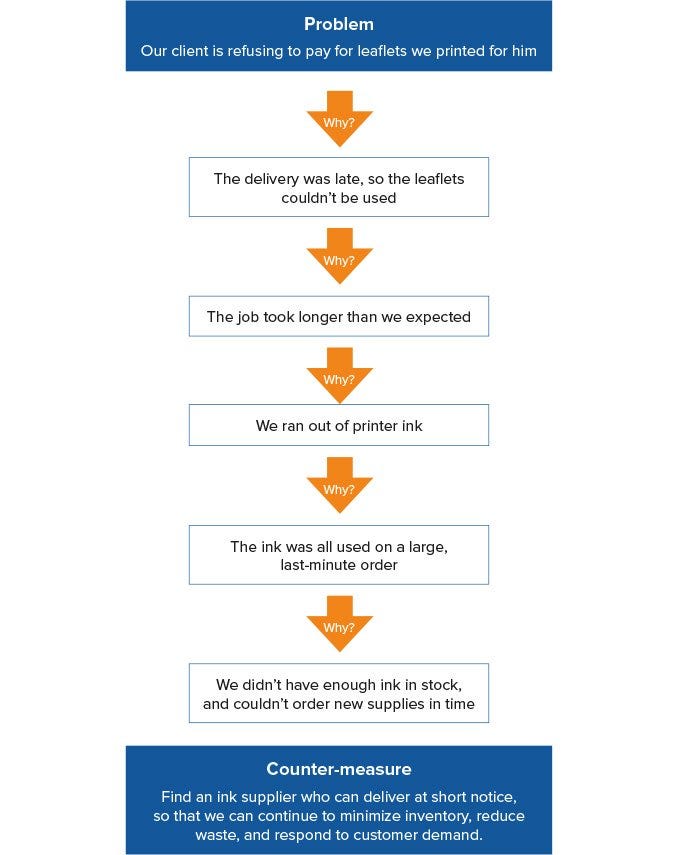
Toyota has the famous “5 Why” framework to identify the root causes of the problems.
From MindTools
So ask more “why” to drill down to the bottom of the problem.