
Dear readers,
Thank you for coming here!
Asking a good question is usually more important than getting a good answer.
Every answer proven great comes from an excellent question.
A good question is constructive and rich of innovations.
It stimulates curiosity, makes people think and learn, and even obtain insights.
A good question may not even need an answer to inspire people.
Then, how to ask a good question?
The ability to ask a good question is rare but much-needed. It comes from both the accumulation of knowledge and the techniques of asking a question.
In this post, let’s go through the key techniques of asking a good question: 4 Don’ts and 3 Dos.

1.Don’t ask rhetorical questions or question the audience
What is a rhetorical question?
“Why don’t you do that?”
“Why have you not done that?”
What is questioning?
“Have you considered the others?”
“Do you think this is being responsible?”
It is easy to notice that all these questions are aggressive.
Behind these questions are negative emotions, such as blaming and anger, which will not help solve the problem.
These questions will only trigger defensive behaviors on the other party and eliminate the possibility for open discussions.
Therefore, never ask rhetorical questions or question the audience
2.Don’t ask a question and then answer it yourself
Asking a question and then answering it yourself, usually is only for expressing yourself, instead of obtaining additional information.
Therefore, what you are really doing is “teaching” or “telling”, instead of “learning” which questions are for.
It only shows your arrogance and hurts the communications.
3.Don’t embed assumptions in your questions
What is “embed assumptions in your questions”?
For example, “Why are your employees so unprofessional?”
This question comes with an assumption “Your employees are very unprofessional”.
This type of question is dangerous, because the assumption may not be true. But once “why” is added to the question, your attention might be drawn away.
You are no longer focusing on this assumption. Instead, you start looking for reasons for the assumption.
This is like “injecting” an assumption into your brain.
Of course, this kind of “tricks” can be much harder to spot in real life than the example above.
But people sooner or later will realize it and will feel insulted.
Therefore, we should never embed assumptions in our questions. And we need to be alert about this type of questions ourselves as well.
4.Don’t ask “Yes or No” questions
These are close-ended questions. The audience can simple answer with “Yes or No”.
These type of questions are bad in obtaining information and bring people inspirations.
Therefore, ask open-ended questions.
5.Do apply the 5W1H approach
What is 5W1H?
“What”, “Who”, “Why”, “When”, “Where”, “How”!
Any question that starts with these words could be a good question. They could be questions on facts, logic, reasoning, relationship, time or behavior.
They are open-ended questions and do not come with any pre-judgement or positioning.
Therefore, these questions are good for discussion and insight generation.
6.Do ask to confirm the facts before asking “Why”
This is a good way to avoid #3 “embed assumptions in your questions”.
So ask to confirm the assumptions first before asking “Why”.
This way, what we are doing is trying to identify the reason for the fact, instead of trying to “inject” any opinion into people’s mind.
7.Do ask follow-up questions
One question might not be enough, especially when we are dealing with more and more complex problems in our modern life.
Therefore, follow-up questions are necessary to obtain more information and drill down to the root-causes.
Toyota has the famous “5 Why” framework to identify the root causes of the problems.
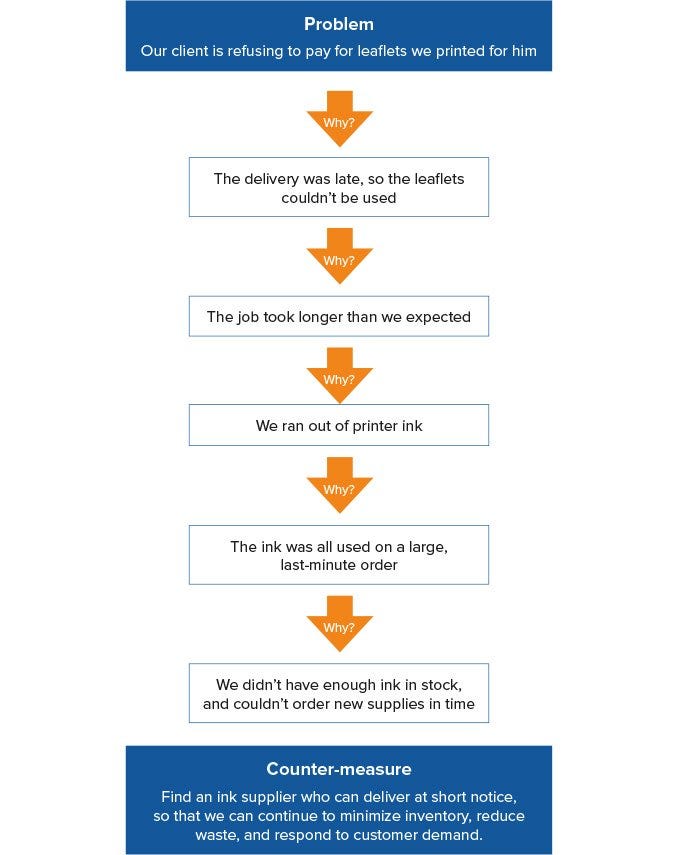
So ask more “why” to drill down to the bottom of the problem.

In Summary, 4 Don’ts and 3 Dos in asking good questions:
1.Don’t ask rhetorical questions or question the audience
2.Don’t ask a question and then answer it yourself
3.Don’t embed assumptions in your questions
4.Don’t ask “Yes or No” questions
5.Do apply the 5W1H approach
6.Do ask to confirm the facts before asking “Why”
7.Do ask follow-up questions
The goal of asking questions is effective communication, new learnings and to solve actual problems.
It is not for blaming others or expressing ourselves or showing off and especially not for “injecting” opinions out of ill intent.
A good question is constructive, rich of innovation, and most importantly, honest and open.
It stimulates curiosity, makes people think and learn, and even obtain insights.
The ability to ask a good question is rare but much-needed. It comes from both the accumulation of knowledge and the techniques of asking a question.
Hope we all possess the ability to ask good questions!
Till next time!