Thursday, January 28, 2021

3 “Wisdom” to have a “Big Say” in life!

Photo by Tingey Injury Law Firm on Unsplash

Dear Readers,

Thank you for coming here!


How to have a “Big Say” in life and achieve success and happiness?

We need “Wisdom”. The world is too complex and uncertain, we need “Wisdom” to guild us.

How much “Wisdom” one possesses could be the factor to set people apart.

In life, we need 3 “Wisdom”: The “Wisdom” to choose, stick to our choice and game with the world.


Photo by Javier Allegue Barros on Unsplash

1.The Wisdom to Choose

Life is full of choices and we define our lives with the choices we make.

Should I start my own business or live a corporate life?

Should I choose City A or B?

Should I marry Ruby or Debby?

Should I eat Nasi Lemak or Kway Chap for lunch?

…

Fortunately and Unfortunately, there are only a few critical choices we get to make in our lives.

However, many of us do not (want to) know we have choices and do not have the courage to choose.

Why do many of us not know the choices we have?

If you are reading this, you are living in a time of peace and abundance. You have the right to choose, which is the freedom people in history crave for.

Think about Frank.V.E., the author of “Man’s Search for Meaning”. He lived in desperate conditions, saw his peers disappearing day by day and chose to have hope and dignity while waiting for his turn. 

He kept the “last freedom” mankind can have: the freedom to choose attitude.

Compared to him, we have the freedom to choose. No matter our choices, the chances of us ending up in his situation is almost non-existent.

The only problem is whether we realize it or rather whether we want to realize it.

Are we just repeating our lives every day, knowing that we are not as happy as we can be but keeping telling ourselves that we do not have a choice, because of kids, housing loans etc etc

Do we really not know that we have a choice to change or do we just not want to know?

Why do many of us not have the courage to choose?

Even through we realize the choices we have, many of us still dare not to make the call.

Because choosing one means giving up the other.

Starting your own business is exciting and fulfilling, but it is also hard work with too many uncertainties.

Going into corporate is stable with good benefits, but it is also boring and dull.

So how?

Do not escape from it and do not be too greedy.

Escaping from it usually leads to the worst decision in the last minute because we either choose in the moment of stress or someone else will choose for us.

Being too greedy is no better.

You could list out all the qualities for your future soul mate. Then you list out all the possible candidates and evaluate them with different models, and then tell the “lucky girl” that she is the one.

She could tell you “Sorry, you are not my type” or even worse “While you are busy with the evaluation, I got married.”

Maybe we should learn to accept “slightly better than average” results. It will subject us to so much less trouble and pain.

Also, we need to realize “slight better than average” is not bad at all and should be appreciated.

Therefore, make the call and then enjoy the benefits or bear the consequences. 

Always remember: How bad could it be?

Photo by Patrick Tomasso on Unsplash

2.The Wisdom to Stick to Our Choice

To stick to our choice, first we need to stop ourselves from revisiting the choice we have made more than necessary.

Do not look back. Once the choice is made, focus on making it right.

The only time to revisit and make adjustment is when critical new information and development become known. 

However, we need to be clear about the core logic behind the decision and stick to it.

The second thing we need to be aware of is distraction.

There are so many nowadays. They can come to us disguised as opportunities, wealth, love etc etc

The right way to counter it is a phase I have used probably too much — “Long-Term”.

Jeff Bezos pushed his “Flywheel” for 20 years and became the richest person in the world, because “It’s All About Long-Term”.

He had countless opportunities to raise the profit margin of Amazon and push the stocks higher. But he did not to stick to the Long-Term.

Probably, shareholders have doubted him or even blamed him.

Maybe, he never thought of giving this up, because all he cares is Long-Term.

Make the choice and give it time by sticking to it.

Photo by Zoe Holling on Unsplash

3.The Wisdom to game with the world

The world is full of competitions in all aspects.

It is an elegant technique to achieve what we want in the interactions with others, e.g. negotiations.

We need to “Game” with the world, as in “Game Theory”. 

And remember, most of the time, we are not playing one-time games.

So how to game?

One mindset and one tactic.

Mindset : Win-Win & Gratitude

Always try to achieve Win-Win. This is the only way to maintain a healthy long-term working relationship.

As a consultant, say no when you know you cannot solve the clients’ problem.

In a project, lower your margin to allow some margin for the other party too.

…

Gratitude is not only the right thing to do, but also a necessary condition to attract partners.

Will you work with someone who has the reputation of being ungrateful? 

Even if you do, it is only for the moment. Once the short-term goal is achieved, you are gone. 

And you know during the short cooperation, you need to constantly keep an eye on the other party.

Win-win and gratitude do not guarantee the maximized benefits for us now, but for the Long-Term.

Tactic: Repeat the last choice of your opponent

In a repeated game, repeat the last choice of your opponent gives the best results, by computer simulation.

Always being a nice guy will attract bullies; Always being a bully will repel others.

“Blood for blood” is a protection to ourselves.


Photo by Kelly Sikkema on Unsplash

In summary, make your choice decisively, stick to it for the Long-Term and repeatedly game with world, until you achieve your goals.

This is what sets people apart!

This is how to have a “Big Say” in our lives!


Till next time!

Tuesday, January 26, 2021

Monthly Net-Worth Update —Jan 2021


Photo by Micheile Henderson on Unsplash

Dear Readers,

Thank you for coming here!


Time flies! 

The first month of 2021 is coming to an end. I hope things are well for all of us!

Here comes another monthly update of our Net-Worth.

It is a great month, partly because of my mistake last month.


Net-Worth increase from last month: 49.92K SGD, 0.72KG Gold

It is a pretty good increase in monetary value.

The increase was mainly from investment returns. I was really lucky since I decided to change my investment approach to move away from DCA into broad-index only.

The sum of money poured into the market did bring some benefits for now.

I will continue to report my transactions in this blog.

The rest of the increase came from salaries, CPF interest and also a mistake from last month.

I made a mistake in my tracking template last month and failed to capture some value in last month numbers. I did not realize that until today.

So the actual increase was less than the number above.

Photo by Michael Longmire on Unsplash

Investment: 8.34% annualized return, incl. dividend

This is almost double the return of last month and it is the 2nd highest return rate we have achieved since the start of the investment journey.

Again, I have been lucky with the change of investment approach.


Happy investing and FIREing!


Till next time!

Sunday, January 24, 2021

My Market Transactions — Wk 4 2021

Photo by Chris Liverani on Unsplash

Dear Readers,

Thank you for coming here.


Another update on my transactions in the past week.

I might be getting a bit too trigger happy now and did my first ever speculation. 


Over the past week, I made the following transactions:


Capital injection: ~30KSGD

1.China Southern Airlines:

I have been thinking about adding more shares since last week, but was not able to the get the price we wanted. 

On Tuesday, with the huge inflow of funds into the HK stock market, the stock rose by more than 5% shortly after the market opened. 

I panicked and was afraid of missing the ride. So I added about 25K worth of shares at pretty much the highest point. 

And now it is the #1 stock in the loss.

So lesions learned for me:

  1. Make up my mind. If the decision is to add more shares, then do not mind the few cents too much.
  2. Do not panic. 
  3. Do not be afraid of missing the ride. There is no way to catch all the rides. Not losing money is more important.


2.Marathon Patent Group Inc

My first ever speculation attempt with a small amount. 

I bought it on Thursday and sold it on Friday with about 8% profit.

Photo by MayoFi on Unsplash

Capital outflow: ~7KSGD

1.Marathon Patent Group Inc

As mentioned above.


Happy Investing!

Till next time!

Friday, January 22, 2021

A good question is more important than the answer — How to ask a good question?

Photo by Brett Jordan on Unsplash

Dear readers,

Thank you for coming here!


Asking a good question is usually more important than getting a good answer. 

Every answer proven great comes from an excellent question.

A good question is constructive and rich of innovations.

It stimulates curiosity, makes people think and learn, and even obtain insights.

A good question may not even need an answer to inspire people.

Then, how to ask a good question?

The ability to ask a good question is rare but much-needed. It comes from both the accumulation of knowledge and the techniques of asking a question.

In this post, let’s go through the key techniques of asking a good question: 4 Don’ts and 3 Dos.


Photo by Tachina Lee on Unsplash
1.Don’t ask rhetorical questions or question the audience

What is a rhetorical question? 

“Why don’t you do that?”

“Why have you not done that?”

What is questioning?

“Have you considered the others?”

“Do you think this is being responsible?”

It is easy to notice that all these questions are aggressive.

Behind these questions are negative emotions, such as blaming and anger, which will not help solve the problem.

These questions will only trigger defensive behaviors on the other party and eliminate the possibility for open discussions.

Therefore, never ask rhetorical questions or question the audience

2.Don’t ask a question and then answer it yourself

Asking a question and then answering it yourself, usually is only for expressing yourself, instead of obtaining additional information.

Therefore, what you are really doing is “teaching” or “telling”, instead of “learning” which questions are for.

It only shows your arrogance and hurts the communications. 

3.Don’t embed assumptions in your questions

What is “embed assumptions in your questions”?

For example, “Why are your employees so unprofessional?”

This question comes with an assumption “Your employees are very unprofessional”.

This type of question is dangerous, because the assumption may not be true. But once “why” is added to the question, your attention might be drawn away.

You are no longer focusing on this assumption. Instead, you start looking for reasons for the assumption.

This is like “injecting” an assumption into your brain.

Of course, this kind of “tricks” can be much harder to spot in real life than the example above.

But people sooner or later will realize it and will feel insulted.

Therefore, we should never embed assumptions in our questions. And we need to be alert about this type of questions ourselves as well.

4.Don’t ask “Yes or No” questions

These are close-ended questions. The audience can simple answer with “Yes or No”.

These type of questions are bad in obtaining information and bring people inspirations.

Therefore, ask open-ended questions.

5.Do apply the 5W1H approach

What is 5W1H?

“What”, “Who”, “Why”, “When”, “Where”, “How”!

Any question that starts with these words could be a good question. They could be questions on facts, logic, reasoning, relationship, time or behavior.

They are open-ended questions and do not come with any pre-judgement or positioning. 

Therefore, these questions are good for discussion and insight generation.

6.Do ask to confirm the facts before asking “Why”

This is a good way to avoid #3 “embed assumptions in your questions”. 

So ask to confirm the assumptions first before asking “Why”.

This way, what we are doing is trying to identify the reason for the fact, instead of trying to “inject” any opinion into people’s mind.

7.Do ask follow-up questions

One question might not be enough, especially when we are dealing with more and more complex problems in our modern life.

Therefore, follow-up questions are necessary to obtain more information and drill down to the root-causes.

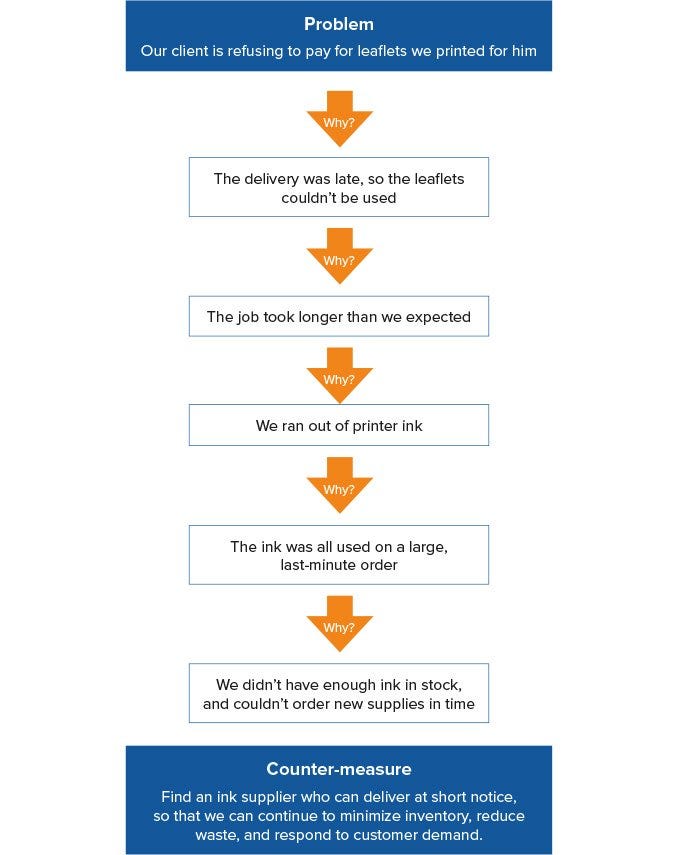
Toyota has the famous “5 Why” framework to identify the root causes of the problems.

From MindTools

So ask more “why” to drill down to the bottom of the problem.


Photo by Kelly Sikkema on Unsplash

In Summary, 4 Don’ts and 3 Dos in asking good questions:

1.Don’t ask rhetorical questions or question the audience
2.Don’t ask a question and then answer it yourself
3.Don’t embed assumptions in your questions
4.Don’t ask “Yes or No” questions
5.Do apply the 5W1H approach
6.Do ask to confirm the facts before asking “Why”
7.Do ask follow-up questions

The goal of asking questions is effective communication, new learnings and to solve actual problems.

It is not for blaming others or expressing ourselves or showing off and especially not for “injecting” opinions out of ill intent.

A good question is constructive, rich of innovation, and most importantly, honest and open.

It stimulates curiosity, makes people think and learn, and even obtain insights.

The ability to ask a good question is rare but much-needed. It comes from both the accumulation of knowledge and the techniques of asking a question.

Hope we all possess the ability to ask good questions!


Till next time!

Wednesday, January 20, 2021

Where does Money come from?!

Photo by Erik Mclean on Unsplash

Dear readers,

Thank you for coming here!


I read about an interesting research on “Where does Money come from?” the other day. 

It was done in 2019 so it is a bit outdated, but I believe things should not have changed much over the last two years.

Therefore, I would like to share it with you in this quick read.


Where does Money come from?

In 2018, 

  • 73% of the income of Chinese residents came from work — “People-generating money”
  • 27% came from investments — “Money-generating money”
  • In US, even for the richest families, about half of the income came from work

I think it tells us two things to get money.

1.Focus on improving our work efficiency and output

It is clear that work generates most of the income for the mass population.

And that is just the average.

That means, for some people, work can even generate more than 100% of their wealth. That is what happened to me when I first started investing, with negative returns.

Therefore, to accumulate wealth, the best way for most is to focus on improving our work efficiency and output and use that to trade for wealth.

This is especially true when we do not have big enough capital.

2.Start investing as early as possible and make it a continuous journey

On the other hand, 27% is significant. 

Therefore, we should definitely not ignore it. No matter we like it or not, investing is going to be a “must” for us. 

I did not start investing until past my 30. If possible, you should start as early as possible. 

The earlier you start, the less costly your mistakes will be and the more time you will have to make compounding work to your favor.

And it should be a continuous journey. And I mean two things.

  1. You should spend time on it continuously to learn and practice. Spend time on money related staff at least every week.
  2. You should keep exploring new things, not limiting yourself due to laziness. I limited myself into “DCA into ETFs” without knowing there are so many other ways to invest.

This does not contradict with the first point. Time will be available if you really think it is important.

I did not spend extra time on work before I started investing. I spent it on gaming, movies and etc.

Besides, focusing on just one thing, as many tell us, sounds so boring.

I think we can manage to do two things well! 

Happy work and Happy investing and Happy getting rich!


Till next time!

Sunday, January 17, 2021

My Market Transactions — Wk 3 2021


Photo by Chris Liverani on Unsplash

Dear Readers,

Thank you for coming here.


Another update on my transactions.

I might be enjoying the buying a bit too much. I think I need to slow down.


Over the past week, I made the following transactions:


Capital injection: ~16KSGD


1.Semiconductor Mfg Intl 

This is the leading enterprise for Chinese Chips. 

The share price kept shooting up. We have decided to buy more, at a much higher price than the first transaction of course.

We believe there is still potential and also this is the compare we are willing to bet on for the long-term.

The price did drop a bit after our second buy. Let's see how it performs going forward.


Photo by MayoFi on Unsplash

Capital outflow


None.

But I am seriously thinking of clearing my ES3 positions. The index is just not moving. 

We are still making the decision,


Happy Investing!


Till next time!

Friday, January 15, 2021

How to be a good employee (10 times the salary in 10 years) — Part 4: Take the right responsibilities

Photo by Mario Gogh on Unsplash

Dear readers,

Thank you for coming here!


This is the episode 4 of the “Good employee” series.

When I thought of this topic, I struggled to decide whether this would be a better fit for the “Good manager” series.

However, I did get this idea as an employee. It would be good for employees to take the manager’s perspective from time to time anyway.

Moreover, I am an individual contributor now (aka employee) and I do not know whether I will have enough material to continue the “Good manager” series.

Therefore, I decided to post it here in the “Good employee” series.


When I think of my past experiences, there are two types of responsibilities I take on, corresponding to the “Positive” and “Negative” mindset I follow in different stages of my career.

Type 1: The responsibilities to deliver success — Positive mindset

Type 2: The responsibilities to take punishment for failure — Negative mindset


Type 1 is like saying “Just leave it to me. I will make it happen.”

This requires motivation and pro-active problem-solving. There is no room for excuses and we need to give it our very best.

We take it on ourselves to overcome whatever difficulties and roadblocks.

This mindset usually improve things.


Type 2 is like saying “If this fails, you can blame it on me.”

No doubt, this is not easy either. This requires courage and accountability.

However, this could be used to justify not trying and not caring.


As a manager, Type 2 is a must. A good manager will take accountability and the consequences for their team’s failure.

Type 1, however, could harm the team’s performance because it brings the risk of micro-management and dictatorship.


But as an employee, we have to take Type 1 responsibilities. 

We are hired to make things happen. That is why we are here. Otherwise, we would have been of no use to corporations.

As an employee, we actually do not have the option to take Type 2 responsibilities, because they always fall on the organization and then our managers first. We at most take a small part of them.

Therefore, as an employee, we need to devote all our proactiveness to make things happen.

The other way is not really a choice. 


Photo by Tim Marshall on Unsplash

Maybe the best team will have managers take Type 2 responsibilities and members take Type 1 responsibilities.

And, the opposite would no doubt be the worst set up.

When employees are made to take Type 2 responsibilities, they will also try to avoid Type 1 responsibilities.

Can you imagine saying “Just leave it to me. I will make it happen” to a manager who will punish you for the failure?

So in conclusion:

As a manager, take Type 2 responsibilities always (maybe this is not a choice either) and show it to your team. Be cautious with Type 1 though.

As an employee, Type 1 is the only type for us. Take it and give it our best in a team where managers take Type 2. If we are unluckily in a team where managers avoid Type 2, protect ourselves until we quit for a better team.


Till next time!